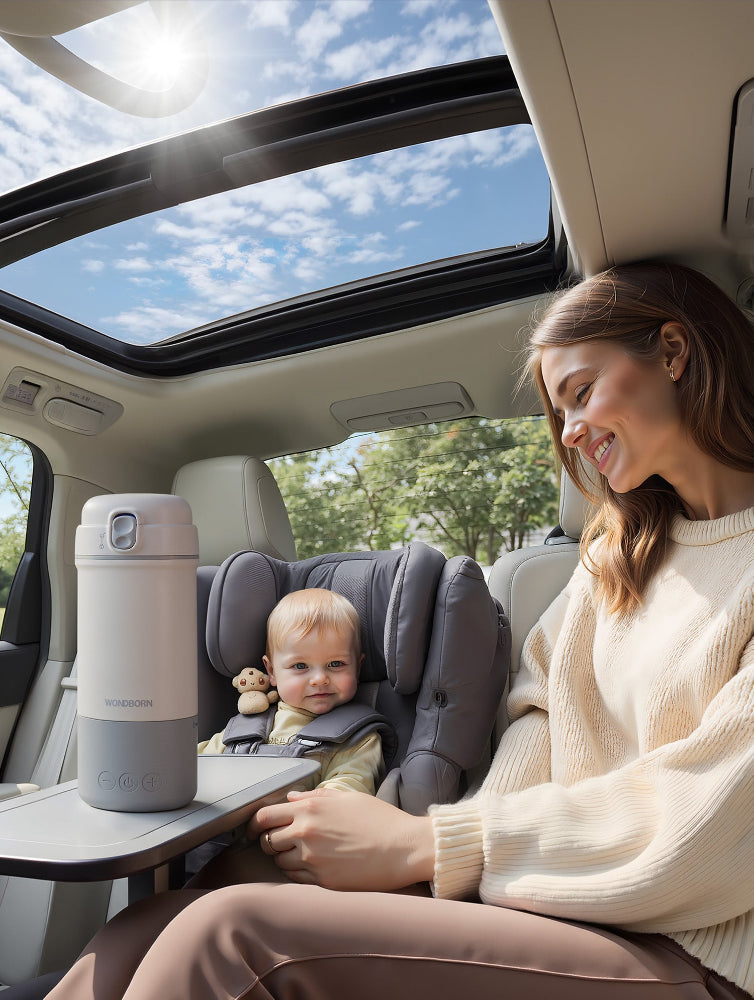

When you are preparing for a new baby, the checklist of newborn essentials can feel endless. Among the cribs, diapers, and strollers, choosing your first bottle warmer often gets pushed down the list. However, finding a reliable way to warm milk is critical for your baby's health and your own sanity during those exhausting night feeds.
Choosing a warmer is not just about convenience; it is about protecting your newborn's developing digestive system. This guide will walk you through why safety should be your top priority and how to find the safest bottle warmer for your family.
Why "Safety First" Matters for Your Newborn's Gut
When parents search for a safety first bottle warmer, they usually want to avoid physical burns. But true safety starts inside your baby's stomach. A newborn's gut is highly sensitive, and how you warm their milk directly impacts their digestion and immunity.
1. Protecting Living Antibodies and Enzymes
Breast milk is a living fluid. It contains active digestive enzymes (like lipase) and living antibodies that coat the baby's intestinal lining, creating a shield against infections and helping to prevent severe gas or colic. If you warm breast milk in bottle warmer that uses unpredictable boiling water, temperatures can easily spike past 104°F (40°C). At this temperature, according to medical consensus on breast milk preservation, those vital immunological properties begin to break down and are instantly destroyed by extreme heat. Precise temperature control is non-negotiable.
2. Avoiding Microplastics and Chemical Leaching
Traditional warming involves submerging a plastic baby bottle into a bath of steaming hot water. Repeatedly heating plastics accelerates material degradation. A landmark 2020 study published in Nature Food revealed that heating plastic (polypropylene) baby bottles can release millions of microplastic particles directly into the liquid, raising valid concerns about chemical leaching into your baby's milk. The safest approach is to remove plastics from the heating process entirely.
3. The Bacterial "Danger Zone" and Residual Heat
According to the USDA, bacteria multiply rapidly when food or milk sits in the "Danger Zone" — temperatures between 40°F and 140°F. Traditional water-bath warmers pose a hidden risk: even if the machine "turns off" on a timer, the hot water surrounding the bottle continues to transfer residual heat, overcooking the milk and potentially creating a breeding ground for bacteria if left too long. A modern, safe warmer avoids this by hitting the exact target temperature and instantly switching to a Keep-Warm mode, holding the milk safely at body temperature without continuing to heat it.
Choosing Your First Warmer: What to Look For
| Feature | Traditional Water-Bath Warmer | Modern Precise Warmer Cup |
|---|---|---|
| Heating Method | Surrounds bottle with hot water (fluctuates). | Direct heating against controlled surface (1℉ precision). |
| Material Safety | Heats plastic bottles in boiling water. | Pours milk directly into food-grade stainless steel. |
| Ease of Use | Requires measuring water and calculating time. | The easiest way to warm a bottle: Pour, set temp, and wait. |
| Heat Management | Residual hot water continues to cook the milk. | Stops at target temp and holds Keep-Warm mode. |
The Evolution of the Safest Bottle Warmer
When looking at the evolution of baby gear, the WONDBORN Portable Bottle Warmer represents the next generation of safe feeding. It abandons the outdated, messy water-bath system entirely.
Instead of dealing with water levels and plastic bottles, you simply pour breast milk or water directly into the wide-mouth, premium food-grade stainless steel cup. The microchip technology allows for exact 1℉ temperature control. Once the liquid reaches the safe target temperature (like 98.6°F), the device stops actively heating and enters a consistent Keep-Warm mode. This means the milk is perfectly ready whenever your baby wakes up, with zero risk of overheating or nutrient loss. It is widely considered the safest bottle warmer design for preserving breast milk integrity.
Why Your First Warmer Should Be Portable
When building a newborn essentials checklist, many parents assume a portable bottle warmer is only necessary for vacations. In reality, the cordless freedom of a portable device solves daily feeding challenges far better than a stationary unit.
| Usage Scenario | Traditional Stationary Warmer | Modern Portable Bottle Warmer |
|---|---|---|
| Night Feeds | Requires a trip to the kitchen or wall outlet. | Nightstand Ready: The easiest way to warm a bottle directly from bed. |
| Around the House | Stuck on the kitchen counter. | Cordless Freedom: Warm milk safely in the living room or nursery. |
| Park & Stroller | Useless without a wall plug. | On-the-Go Ready: Fits into stroller cup holder anywhere. |
| Road Trips | Requires slow car adapters and messy baths. | Travel Friendly: Battery-operated and spill-proof. |
1. Breaking the Kitchen Tether
New parents should not be confined to the kitchen. A cordless warmer allows you to maintain a precise, safe feeding routine wherever you and your baby are most comfortable. You are no longer limited by the length of a power cord.
2. Emergency Preparedness
Power outages from severe weather can instantly render a traditional plug-in warmer useless. A battery-operated device with USB pass-through charging acts as a vital backup. For emergency situations, this is the safest bottle warmer option you can have on hand.
3. Seamless Caregiver Handover
When it is time to leave your baby with grandparents or a nanny, complex water-bath warmers can lead to confusion and accidental overheating. A portable, direct-pour cup offers a foolproof solution. It eliminates the guesswork, making it the absolute safest and most stress-free option for anyone watching your baby.
FAQ: Common Questions from New Parents
Conclusion
Choosing your first bottle warmer is a vital step in setting up a safe feeding routine for your newborn. By prioritizing exact temperature control, food-grade materials, and a smart Keep-Warm function, you protect your baby's delicate gut and preserve the essential nutrients in every feed.
Resource: Centers for Disease Control and Prevention (CDC) - Proper Storage and Preparation of Breast Milk.
Resource: Nature Food Journal - "Microplastic release from plastic baby bottles" (Li, D., Shi, Y., Yang, L. et al. 2020).
Resource: U.S. Department of Agriculture (USDA) - "Danger Zone" (40°F - 140°F).