Welcome to parenthood! The first twelve months with your newborn are filled with beautiful milestones, but they also bring a lot of hidden worries—especially when it comes to hygiene. As a new parent, ensuring your baby’s feeding gear is completely sanitary is a daily top priority.
When shopping for a reliable first years bottle sterilizer, you might be overwhelmed by the specs. Why do we emphasize a 99.999% kill rate? And why is the old-school boiling method no longer the best choice? Today, backed by guidelines from authorities like the American Academy of Pediatrics (AAP) and the Centers for Disease Control and Prevention (CDC), we are breaking down the science of keeping your baby safe during their most vulnerable stage.
1. Why 99.999% Deep Sterilization is a "Must-Have" at Certain Stages
Not all sterilization standards are created equal. While a 99.9% kill rate might be sufficient for an adult, that tiny fraction of a percent makes a world of difference for a baby in specific developmental stages.
-
Who Needs 99.999% Protection? According to the NIH's research on the immature immune system, newborns rely heavily on maternal antibodies. The Mayo Clinic's infant health overview notes that babies (especially 0-3 months old) require the strictest hygiene standards.
-
The Necessity of Deep Sterilization: Common foodborne pathogens pose fatal risks to newborns. The CDC explicitly recommends rigorous sterilization because dangerous bacteria like Cronobacter can survive in dry environments, making ordinary washing insufficient.
-
The Mathematical Logic: If a baby bottle has 1,000,000 bacteria on it, a 99.9% kill rate leaves behind 1,000 surviving bacteria. However, a 99.999% deep sterilization rate leaves a mere 10 bacteria. This 100-fold increase in safety protects your baby's fragile digestive system from severe diarrhea or oral thrush.
2. Daily Sterilization Guide: When and How?
Many parents confuse "cleaning" with "sterilizing," but they are two very different steps.
-
When Do You Need to Sterilize? At least once a day. According to the NHS (National Health Service), all feeding equipment must be sterilized before every use until your baby is at least 12 months old.
-
Step 1: Thorough Cleaning. A sterilizer does not have a washing function. Following the CDC's cleaning guidelines, you must first wash bottles and accessories in hot, soapy water to remove all milk residue.
-
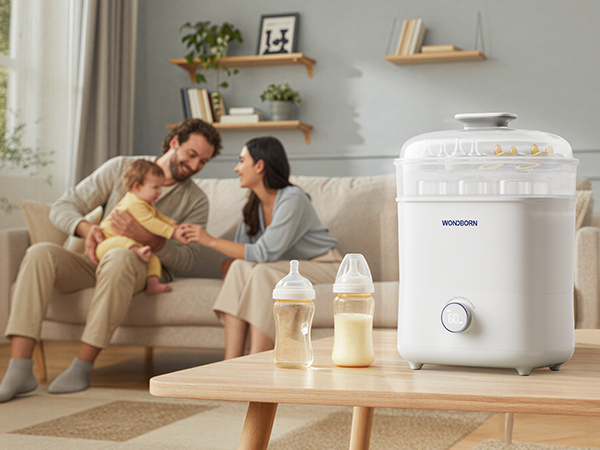
Step 2: Machine Sterilization. Compared to the burn-prone method of boiling—which the Cleveland Clinic warns can degrade plastic over time—a modern electric steam sterilizer provides a one-touch solution. As noted in Healthline's sterilization guide, steam penetrates every microscopic crevice. Using an appliance with a 60-minute Auto Mode guarantees that 99.999% kill rate.
3. After Sterilization: How to Scientifically Prepare a Bottle
Even the most rigorous sterilization can be undone by improper milk prep. Maintaining that sterile environment is essential, a standard echoed by NHS.
Handling Breast Milk Safely
When storing pumped milk, CDC's breast milk handling standards advise using completely dry, sterilized containers so that residual water doesn't dilute the milk's immune-boosting properties.
-
Prep and Pump: Take a dry bottle directly from the sterilizer's rack.
-
Seal and Label: Cap the bottle tightly and label it with the date.
-
Store: According to Healthline's storage guide, milk can stay at room temperature for 4 hours, or in the fridge for 4 days.
-
Warm Safely: Never microwave breast milk. Warm the bottle gently in water.
Preparing Powdered Formula
Powdered infant formula is not sterile. The World Health Organization (WHO) strongly recommends a specific process:
-
Boil the Water: Bring safe water to a rolling boil.
-
Cool Slightly: Allow it to cool so it remains at or above 70°C (158°F).
-
Mix: As per AAP formula mixing guidelines, pour the water into the sterile bottle first, then add the powder.
-
Cool Rapidly: Cool the bottle immediately under cold water.
4. FAQ: Caring for Your Breast Pump Parts
Breast pumps are a mother's best friend, but their intricate parts require special attention.
-
Q: Do I need to sterilize breast pump parts after every use?
A: Yes. The FDA strongly advises cleaning and sterilizing pump parts after each session.
-
Q: Are all pumps compatible with sterilizers?
A: Modern large-capacity sterilizers fit all flanges. The FDA on breast pump safety stresses using designated hygiene practices for your specific pump type.
-
Q: How do I dry all these tiny accessories?
A: Lingering moisture breeds fungus, which can lead to Thrush (Mayo Clinic's thrush overview). Utilize a machine with a HEPA drying function. If an infection does occur, consult WebMD Remedies and your pediatrician.
Conclusion: Investing in Your Baby's First Year
Navigating your baby's first year is demanding. By choosing a comprehensive first years bottle sterilizer that offers 99.999% deep sterilization, HEPA-filtered drying, and 72-hour storage, you are investing in your baby’s health (Cleveland Clinic feeding guide) and reclaiming your own precious time.